
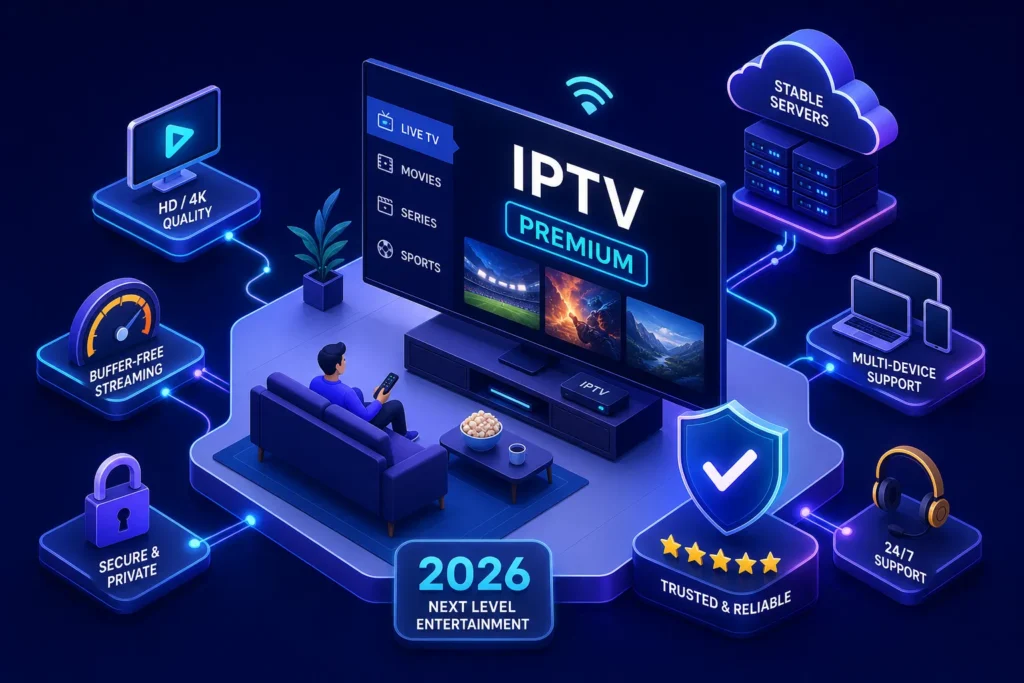
There are hundreds of IPTV subscription services out there, and most “best of” roundups just list names with a star rating and move on. That doesn’t help you figure out whether a service will actually work on your Firestick, carry the channels your household watches, or hold up during a Champions League final. If you pick the wrong one, you’re out the subscription fee and stuck starting over. Finding the best IPTV service for your household takes more than skimming a comparison chart, it takes knowing what to actually measure.
After a decade of running and testing IPTV services, including operating Best IPTV Service, I’ve seen exactly what separates a service worth paying for from one that looks good on paper and falls apart in real use. This guide is built around four evaluation criteria: content library size and quality, stream reliability, device compatibility, and pricing transparency. Every section runs through at least one of those filters.
By the end, you’ll have a clear framework for evaluating any live TV streaming service and a specific top pick to start with. No guesswork required.
The four things that actually make an IPTV service worth subscribing to
Why most “best of” lists miss the point
A list ranking 15 IPTV providers rarely tells you why one is better than another. It recites features without context. A 60,000-channel count means nothing if 40,000 of those channels buffer constantly or go offline every time there’s a major live event. Raw numbers are marketing, not evaluation.
The four criteria that actually matter are: content library size and quality, stream reliability, device flexibility, and pricing transparency. These are the filters this guide uses throughout. When a service scores well across all four, it’s worth your money. When it fails even one, that failure shows up in your daily viewing experience.
How to choose the best IPTV service for your specific use case
A few viewer profiles come up more than any others. The sports fan needs live channels with zero lag during peak viewing moments. The cord-cutter replacing cable mainly wants a deep VOD library with some live news and local channels. The international diaspora viewer needs specific regional content, Arabic news, Spanish telenovelas, South Asian cricket coverage, that US-based platforms simply don’t carry.
Each profile weights the four criteria differently. A sports fan cares most about reliability and channel quality. A VOD-focused cord-cutter prioritizes library depth and device compatibility. An international viewer cares most about content coverage. Best IPTV Service scores well across all three profiles, which is why it keeps coming up as the clearest recommendation in this guide.
Channel count and VOD library: what the numbers really mean
Raw channel count vs. content that’s actually useful
Leading paid IPTV providers in 2026 range from 20,000 to 60,000+ live channels, but that range tells you almost nothing useful on its own. What matters is geographic and language coverage, whether those channels are stable day-to-day, and how the VOD library is organized for actual browsing. A service with 20,000 well-curated, reliably streaming channels beats one with 60,000 half-broken feeds every time.
Think about what you actually watch in a week: US broadcast networks, regional sports, maybe a handful of international channels, and an on-demand library for evenings. Most households don’t need 60,000 channels. They need the right 200 to work consistently, plus a strong VOD catalog for when the live schedule doesn’t match their schedule.
Sports, international content, and on-demand titles
The specific content categories US subscribers search for most are live sports, NFL, Premier League, Champions League, PPV events, international channels across Arabic, Spanish, South Asian, and European programming, and on-demand movies and series. The best IPTV subscription services in 2026 carry dedicated sports packages with PPV access and VOD libraries ranging from 40,000 to well over 100,000 titles depending on the provider.
Best IPTV Service offers 20,000+ live channels across every major region, plus 20,000 movies and 13,000 series and anime titles. That’s enough to replace cable, a major streaming subscription, and an international content package simultaneously, all in one plan. For most households, that depth is more than sufficient, and the organization makes finding content straightforward rather than overwhelming.
Streaming quality and reliability: the numbers that actually tell the truth
Uptime and buffering benchmarks you should demand
Reliable IPTV providers in 2026 maintain 99.5%+ uptime. The best services hit 99.8% to 99.99%. Anything below 99% shows up in daily viewing as frequent dropouts, and you’ll feel it most during live sports or breaking news when you can’t afford a stream going dark for 30 seconds. Industry benchmarks consistently place top-tier providers in the 99.8% to 99.99% uptime range over six-month evaluation periods, that’s the standard worth holding any provider to.
Buffering rate matters as much as uptime. Top providers report fewer than 0.2 to 0.4 buffering incidents per hour at 1080p. That’s the practical baseline for what “reliable” means in real-world use. Some services advertise “4K” but are actually upscaling 1080p feeds and relabeling them. Honest providers are transparent about which channels are genuinely 4K versus standard HD.
Why anti-freezing technology is a real differentiator
Optimized global server infrastructure reduces freeze events during high-traffic moments. This is exactly when most budget IPTV services fail: during a major sports final or live broadcast event, demand spikes and under-provisioned servers can’t keep up. The result is freezing and buffering precisely when you’re least willing to tolerate it.
Best IPTV Service uses anti-freezing technology backed by optimized global servers, a specific technical feature, not just marketing language. If you’re evaluating any new IPTV provider, the best test you can run is during a live sports event. That’s peak load, and freeze-prone services expose themselves immediately. A 24-hour trial during a match day tells you more than reading a dozen reviews.
Device compatibility: does it actually work on what you own?
The platforms every serious IPTV service should support
Any credible live TV streaming service in 2026 should work on Amazon Firestick and Fire TV, Android TV, Samsung and LG smart TVs, iOS devices, and Windows and Mac computers. That covers the vast majority of screens in a typical US household. The difference between native apps and sideloaded apps through players like IPTV Smarters Pro or TiviMate is worth understanding: native apps are more reliable with a better user interface, while sideloaded apps offer more flexibility but require a few setup steps to configure correctly.
Roku and Apple TV are still weak points for many providers, so verify support before subscribing if those are your primary devices. Some services technically “support” these platforms through workarounds that require significant effort to maintain. That’s not the same as genuine compatibility.
Multi-connection plans and household use
A household with multiple TVs and devices needs more than one simultaneous connection. In an IPTV context, a “connection” is a single stream playing at one time. If you’re watching live sports in the living room while someone else streams a series in the bedroom, that’s two connections. Leading paid IPTV services offer multi-connection plans, and pricing scales accordingly.
Best IPTV Service supports Smart TV, Firestick, Android, iOS, PC, and Mac, covering the full spectrum of devices a typical US household uses. That cross-device flexibility means you’re not locked into one screen or one setup, which is a meaningful practical advantage over providers that only work well on one or two platforms.
Pricing, trials, and the red flags to watch before you pay
What fair pricing looks like for a full-featured IPTV subscription in 2026
Legitimate, full-featured IPTV services in 2026 range from roughly $5 to $20 per month depending on plan length, channel count, and extras. The pattern across top providers is consistent: 3-month plans typically run $10 to $12 per month, 6-month plans drop to $8 to $10 per month, and 12-month plans bring the effective monthly cost down to $6 to $8 per month for most services.
Best IPTV Service starts at $4.95 per month on the 12-month plan ($41.96 per year), one of the lowest entry
prices in the market for a service at that content and reliability level. For comparison, a standard cable bill runs $70 to $100 per month. Stack Netflix, Hulu Live TV, and a sports add-on on top of that and the bill climbs fast. The math on switching is obvious once you put the numbers side by side.
Trial periods, money-back guarantees, and legality flags
A good trial looks like a 24-hour to 3-day free test period, or a 30-day money-back guarantee. The money-back guarantee is actually the stronger signal: it means the provider is confident enough in their service to let you test it on your actual devices before committing fully. Most providers with short 24-hour trials give you just enough time to confirm the app opens, not enough to evaluate reliability across different viewing scenarios.
The legal dimension is worth addressing directly. IPTV is entirely legal when the provider holds proper distribution rights for the content it streams. Unlicensed services carry real risk for subscribers: service shutdowns with no warning, lost prepaid fees, and ISP infringement notices.
When the service disappears, there’s no recourse. US enforcement has historically focused on operators rather than casual viewers, but the financial loss from a shutdown is immediate and unrecoverable. A practical rule of thumb: if a service has no clear refund policy, no verifiable business presence, and prices that seem too low to sustain a legitimate operation, treat those as red flags. Best IPTV Service backs subscriptions with a 30-day money-back guarantee and includes a free VPN with all plans, particularly relevant for US subscribers whose ISPs monitor streaming traffic and may throttle bandwidth on high-volume connections.
Our top pick: best IPTV service for US viewers in 2026
Why Best IPTV Service checks every box
Running the four-criteria framework against Best IPTV Service produces a clear result. Rather than reciting specs in isolation, here’s how it stacks up across each dimension:
- Content library: 20,000+ live channels spanning every major region, 20,000 movies, and 13,000 series and anime titles
- Reliability: Anti-freezing technology on optimized global servers, built specifically for high-traffic live events
- Compatibility: Full support across Smart TV, Firestick, Android, iOS, PC, and Mac
- Pricing: Under $5 per month on the annual plan with a 30-day money-back guarantee
Beyond the core numbers, two things stand out. The free VPN included with every plan is a practical benefit for US subscribers operating under ISP data monitoring, encrypted streaming traffic prevents throttling and protects viewing history. The 24/7 customer support via WhatsApp is also a genuine differentiator: when something breaks during a live event, you want to reach a real person, not submit a ticket and wait 48 hours for a response.
This is the provider I’d point a cord-cutter, a sports household, or an international viewer toward first in 2026. Not because it’s the only option, but because it consistently delivers on the criteria that actually matter, at a price that makes the decision straightforward.
How to get started without second-guessing yourself
Visit Best IPTV Service, pick the plan length that fits your commitment level, and use the 30-day guarantee to test it on your actual devices at home. The signup flow is quick, you’ll receive confirmation and account credentials by email within minutes of completing checkout. If the service doesn’t deliver the channels and reliability you need, you’re not out anything.
For new IPTV users, starting with a 3-month plan at $12.99 is the right move. It gives you a full quarter to evaluate the provider across different viewing scenarios, live sports weekends, binge-watching sessions, daily news, before committing to a full year. For anyone replacing cable entirely, the 12-month plan at $41.96 makes the math obvious: that’s less than what most people pay for a single month of cable plus one streaming subscription.
The bottom line
Four filters eliminate most of the noise in the IPTV market: channel library quality, stream reliability, device support, and pricing transparency. Apply those consistently and the shortlist gets short very quickly. Most services that look good in a comparison chart fail on at least one of these when you actually use them.
The top IPTV pick for most US viewers in 2026 is the provider that performs reliably across all four areas without overcharging. Best IPTV Service delivers on that standard better than most competitors at this price point, with a content library that covers both international and domestic programming, anti-freezing technology built for live events, full cross-device compatibility, and a price that undercuts cable by a wide margin.
If you’re ready to cut cable or consolidate a fragmented stack of streaming subscriptions into something simpler and cheaper, this is where to start. The 30-day guarantee means the first move is risk-free.